

Every service a provider sells, from business Ethernet and wholesale wavelengths to mobile backhaul and storage networking, is ultimately delivered at the metro edge, within a few dozen kilometers of the customer who pays for it. Here, many small flows at different rates and protocols must reach many sites, often over scarce fiber and into cell sites and street cabinets with little space and no climate control. Dedicating a fiber pair or a wavelength to each customer simply doesn’t scale. Ekinops aggregates any mix of services onto shared 10G, 100G and 400G wavelengths, adds and drops each one exactly where it’s needed, and fits a complete edge node into just 2RU.
Growing service demand at the edge raises several challenges service providers have to solve:
Find answers to common questions about Ekinops optical edge connectivity.
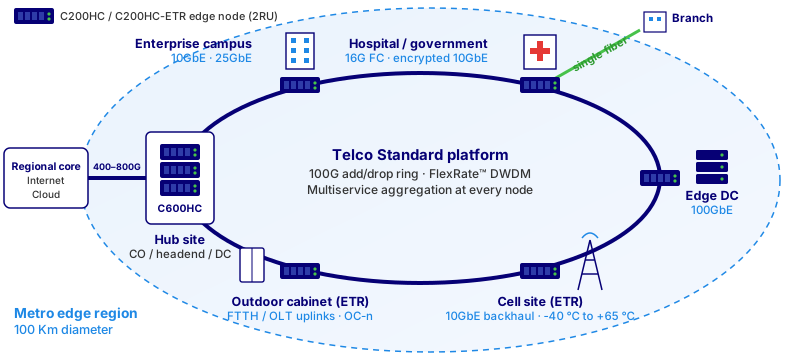
The metro edge is the transport region, typically less than 100 Km across, where a hub site such as a central office, cable headend or data center connects to enterprise campuses, cell sites, outdoor cabinets and edge data centers. Unlike long haul, which carries a few very high-speed channels, the edge carries many small flows that must be aggregated onto 10G, 100G and 400G links before they are handed off to the metro and regional network.
A standard muxponder terminates all of its services at both ends of a link. The PM 100G-XPONDER-MP maps each of its ten client ports into timeslots on east and west 100G OTU4 lines, and each client can be set remotely to Add/Drop, Express or Split & Select. That lets one wavelength drop individual services at any node of a chain or ring, pass others straight through without extra optics, and protect the ones that need it.
The platform supports FE, GbE, 10GbE, 25GbE and 40GbE, OC-3/STM-1 through OC-192/STM-64, OTN and 1G to 32G Fibre Channel. Client ports are software-programmable, so they can be reassigned in the field without affecting other traffic and without forecasting your service mix in advance.
Yes. The 2RU C200HC-ETR chassis, together with extended temperature modules such as the PM O5005MP-ETR transponder, PM O1008MP-ETR muxponder and PM OAC20-ETR amplifier, operates from -40 °C to +65 °C in street cabinets, cell sites and remote huts. It runs on -48 VDC and keeps power consumption low for sites with a limited power budget.
Ekinops supports single fiber working on all line rates from 10G to 800G, transmitting and receiving on the same strand. Routes that would otherwise need a second fiber, or a new build, can still carry full capacity.
Split & Select mode on the PM 100G-XPONDER-MP sends each protected service both ways around the ring and selects the best signal, giving it SNCP-type 1+1 protection. For healthcare, financial and government customers, the PM CRYPTO adds wire-speed, ultra-low-latency AES-GCM 256 encryption to 10G, 40G and 100G services.
Celestis NMS needs only a single Ethernet connection to the near-end shelf, then reaches every other node over a DCN or in-band management channels, so no separate management network to remote sites is required. Auto-discovery, hands-free link turn-up and point-and-click provisioning bring new sites online quickly, and integrated OTDR fiber monitoring pinpoints fiber faults to cut repair time.