Keep every Enterprise site away from outages, link failures, and cyberattacks
For IT and network teams, Ekinops SD-WAN delivers network performance optimization, with built-in security, and central orchestration from a European telecom equipment manufacturer.
Every site depends on reliable connectivity for SaaS, cloud services, payments, and voice. A failed or overloaded link can quickly take a branch or store offline, while multiplying links and appliances adds complexity.
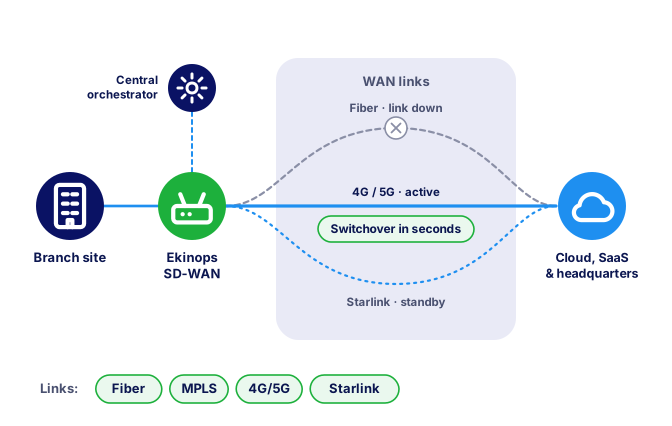
Ekinops builds resilience directly into the network. Its SD-WAN combines multiple access technologies, including fiber, MPLS, 5G, and Starlink, automatically switching traffic to healthy links and prioritizing business-critical applications. Security is integrated into the same architecture, with SSE for web protection and Universal ZTNA for Zero Trust access.
By designing its own routers and OneOS operating system, Ekinops maintains European control across the infrastructure, from hardware to signing keys.
Looking for connectivity beyond security? Discover our Enterprise Networking solutions and build a resilient, secure, and sovereign network for every business location.
WHY IMPLEMENT
Where this makes the biggest difference
A resilient network has to answer three questions most IT and network teams face:
Branches and stores that stay online
Combine fiber, MPLS, 5G, or Starlink on the same site, with automatic switchover to the backup link when the main one fails or degrades.
Critical applications first
More than 7,000 applications and SaaS services are recognized in real time, so business traffic keeps priority when bandwidth drops. Priorities are all customizable.
Deploy and run from one place
Zero-touch provisioning, configuration templates, and a central orchestrator roll out new sites in a repeatable way, without sending a technician.
What happens when a site's main connectivity link fails?
Ekinops SD-WAN continuously measures the quality of every link. When the main link goes down (blackout) or degrades (brownout), traffic is steered to a backup link, such as 4G/5G, within a few seconds. Users keep working, and traffic returns to the main link once it’s healthy again.
Which types of links can be combined?
Fiber, MPLS, 4G/5G, and satellite (Starlink), on the same site and managed simultaneously. That lets you pair a wired link with a cellular or satellite backup that doesn’t share the same physical path.
How does SD-WAN keep critical applications running when bandwidth drops?
It identifies more than 7,000 applications and SaaS services in real time, from the first packet, and applies dynamic traffic prioritization. Business applications and voice keep priority, while less critical traffic adapts.
Can we secure every site without deploying a security appliance in each one?
Yes. With Ekinops SASE, each site gets secure internet access and web filtering the moment it’s connected, through SSE. Universal ZTNA adds Zero Trust access to your applications, with no port exposed to the internet. SSE and Universal ZTNA can also be deployed on their own.
Is this suited to small sites and home workers, or only to large networks?
Both. The same platform covers SMBs, small sites of large enterprises, and dense operator architectures.
Let's Talk
Ready to keep every site online, whatever happens?