

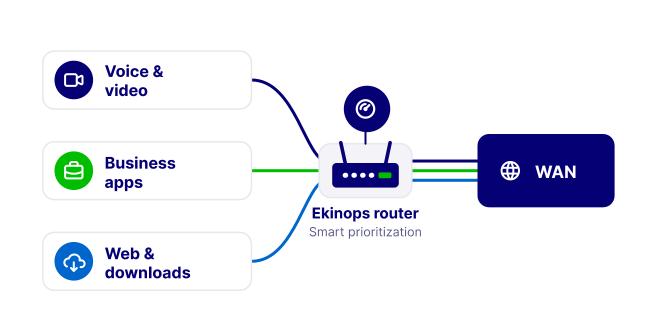
Turn built-in router capabilities into revenue services, activated remotely
Why implement OneOS Built-in Services?
Every new managed service you want to offer, whether it’s a firewall upgrade, better QoS, Business Ethernet or a voice package, traditionally means a truck roll, a hardware swap, or months of integration work before a customer can start using it. Ekinops OneOS Built-in Services flips that as all capabilities are already present in the OneOS6 devices your customers run, and you activate them remotely, on demand, through a software license. What used to be a deployment project becomes a service you can turn on the same day a customer asks for it.
-
Launch Managed Services Without a Truck Roll
Turn on any capabilities remotely on devices your customers already have installed. -
One software for all products and services
OneOS6 combines a broad range of services and is the common operating system for both physical and virtual products. -
Easy management and OSS integration
Concurrent NETCONF/CLI/ TR-069 support for a seamless transition to customer OSS systems.
What this brings to your business



What these built-in services cover
ROUTING & QOS
LAYER 2 SERVICES
SECURITY
TUNNELING & VPNs
VOICE
AUTOMATION & APIs
MANAGEMENT
Dynamic routing and intelligent traffic prioritization
- Full dynamic routing support, including Border Gateway Protocol (BGP) and Open Shortest Path First (OSPF), the two most widely used protocols for exchanging routes between networks.
- Virtual Routing and Forwarding (VRF) runs multiple isolated routing tables on one device, keeping different customers’ or departments’ traffic completely separate on shared hardware.
- Applications Identification and Control (TIC) inspects IP traffic up to layer 7 and classifies packets into categories.
The resulting categories can be used on ingress or egress traffic for QoS classification, Zone Based Firewall filtering, and Netflow export to one or more collectors, or any combination of these. - Quality of Service (QoS) can be enabled on any input and output logical interface. At the input, it is possible to classify packets and mark them with DSCP/precedence value and apply policing. At the output, the same processing is possible as well as traffic shaping and congestion avoidance.
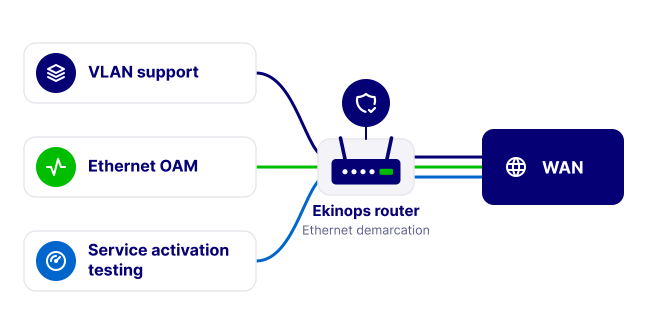
Smarter, safer Ethernet at the edge
- Port-based access control with IEEE 802.1X: Clients are authenticated through EAPOL against a RADIUS server before the port opens. Guest, authentication-fail and native VLANs let you place each client in the right network.
- Precise VLAN and traffic control: Per-port dot1q-tagging rules accept, discard or tag untagged, known and unknown VLAN traffic. Storm control limits broadcast, multicast and unknown unicast floods at both interface and device level.
- Carrier-grade link monitoring with Link OAM: IEEE 802.3ah OAM provides discovery, event notification and remote loopback to check link health and isolate faults quickly.
- Service Activation Testing: Measure the connection throughput and latency before activating the service. Tests are based on RFC2544. All test results, statistics, and errors can be saved in a file.
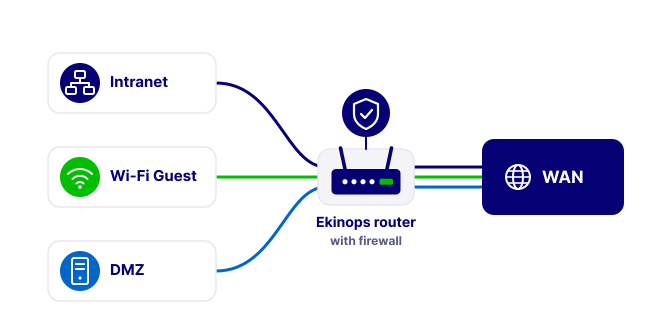
Edge protection built into the same device that routes your traffic
- Stateful, zone-based firewall that tracks sessions and blocks known malicious IP addresses.
- Defends against distributed denial-of-service (DDoS) attacks, both large-scale traffic floods and targeted application attacks.
- Secure boot allows at any software loaded into the device is original Ekinops software, and that the software has not been tampered with.
- Optional Trusted Platform Module (TPM), a secure hardware chip that stores encryption keys separately from the main system, protecting them even if the device itself is compromised.
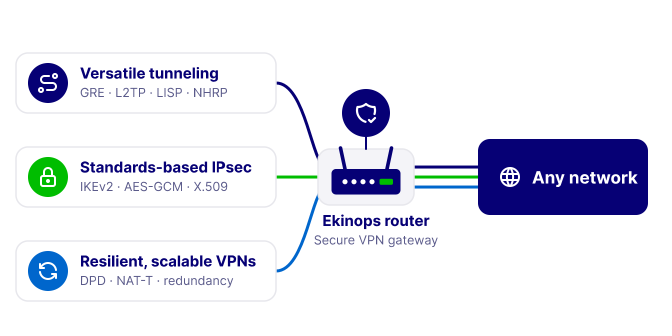
Secure, flexible connectivity across any network, from simple tunnels to enterprise-grade encryption.
- Versatile tunneling: GRE, L2TPv2/v3, 6in4, ISATAP, IPv4-in-IPv4 and LISP carry IPv4, IPv6, Ethernet and VLAN traffic across mixed networks, with NHRP for dynamic endpoint resolution.
- Standards-based IPsec: RFC 4301-compliant AH and ESP in transport or tunnel mode, with IKEv1 and IKEv2, strong encryption (AES-CBC/GCM), SHA-2 hashing, and pre-shared key or X.509 certificate authentication.
- Resilient, scalable VPNs: Dead Peer Detection, NAT Traversal, redundant peers, Reverse Route Injection, Dynamic Virtual Tunnel Interfaces and Group Mode keep links reliable as deployments grow.
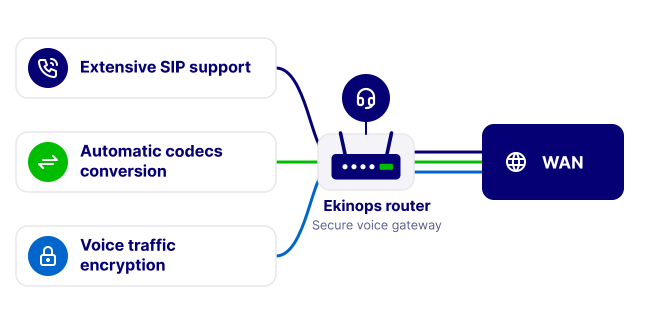
Enterprise Session Border Controller (eSBC) functions on select models
- Full Session Initiation Protocol (SIP) call routing, authentication, and directory integration, including Microsoft Teams Direct Routing.
- Converts between audio codecs (G.711, G.729, G.722, AMR-WB, SILK) automatically, so calls connect regardless of which codec each side uses.
- Encrypts voice traffic end-to-end and hides internal network details from external callers.
- SIP Connect 1.1/2.0 with extensive PSTN/SIP interworking and SIP header manipulation.
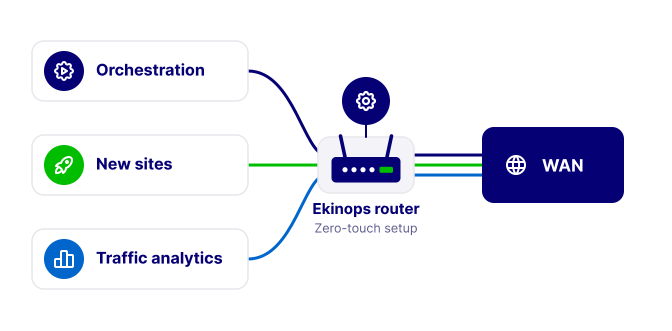
Standardized interfaces for programmatic configuration and zero-touch rollout
- Native support for NETCONF/YANG, standardized interfaces that let orchestration software configures devices automatically, instead of engineers typing commands one device at a time.
- Zero-Touch Provisioning (ZTP) registers and configures new devices automatically the moment they connect to the network, no manual setup required.
- Exports detailed application flow data through NetFlow v9 (a standard format for traffic analysis tools) so you can analyze usage network-wide.
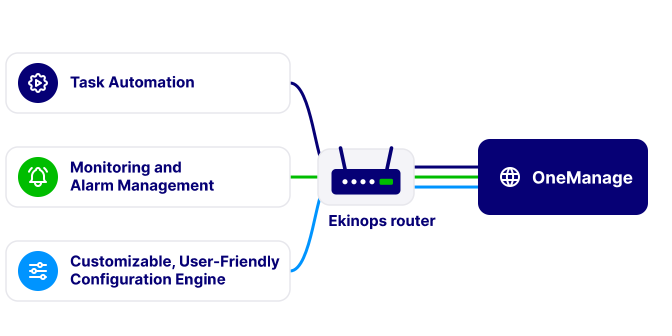
Group, monitor and configure every device from one place
- Task automation: CPE are all members of a group. Groups can be organized in sub-groups. The hierarchical organization of CPE enables an administrator to operate bulk operations on logical groups, such as planning a software upgrade or querying connection status
- Monitoring and Alarm Management: Network status is displayed at a glance with alarmed sites on a map. The operations team can quickly drill-down into graphs from this map and discover the root cause of service degradation.
- Customizable, User-Friendly Configuration Engine: The configuration generation engine is flexible to support complex scenarios. Including scripting within the template enables the ability to generate advanced configuration files. Adding template input parameter controls avoids user input errors and unexpected output configurations.
Go further

They simplify their network services with Ekinops
-
“By introducing a single uCPE deployable at the network edge as the foundation of the ONE portfolio, we enable our partners to operate in a much simpler and more efficient way. Fewer on‑site devices, fewer technical interventions and faster service activation”
Alex LoretteDirector of the Carrier & Wholesale Division at Proximus
-
“Ekinops was the only supplier that could provide a single operating system capable of supporting all our technologies including data and voice. Thanks to Ekinops’ open system approach, we now have complete control over our technology choices. Thanks to OneOS6 we have also been able to reduce the training requirements and decrease costs associated with maintaining multiple operating systems.”
Michal BrcakHead of Product Management Enterprise at T-Mobile CZ
-
“The solution we delivered to VGRD is perfectly seamless, easy-to-operate and to deploy. Now, all ecotel customers can benefit from additional OneOS6 features, such as containers support, Firewall or SD-WAN, without any additional hardware deployment.”
Markus HendrichChief Executive Officer at ecotel
How does remote activation actually work? Do we need to touch the device?
No physical access needed. Once a device is deployed and connected, new capabilities are enabled by applying a software license remotely, through your management platform, without a technician visiting the site.
Does this run the same way on physical and virtual routers?
Yes. The same software runs across our physical access routers and virtualized deployments, so configurations, operational knowledge, and licensing carry over regardless of which form factor your customer runs.
We have customers running OneOS5. What does migration actually involve?
It’s designed for a smooth migration from OneOS5, with simultaneous support for NETCONF, CLI, and TR-069, so you can move customers to modern orchestration at your own pace rather than in one disruptive cutover.
Do the voice (eSBC) features require a separate license or hardware?
It depends on the router model and license. Voice and eSBC functions are available on dedicated access router models, activated through a software license rather than separate voice hardware.
What is VRF, and why would we need it?
Virtual Routing and Forwarding (VRF) lets a single device run several completely separate routing tables at once. In practice, that means you can host multiple customers, or multiple departments, on the same physical router without their traffic ever mixing or one seeing the other’s network.
What does Applications Identification and Control (TIC) actually let us do for our customers?
Applications Identification and Control (TIC) identifies which application is generating traffic in real time, so the device can automatically prioritize something like a voice call or video conference over routine web browsing, without your team manually configuring rules for every application.
Why do NETCONF/YANG matter if we already manage devices through the command line?
Command-line configuration works fine for a handful of devices but doesn’t scale to hundreds or thousands. NETCONF/YANG let orchestration software configure many devices consistently and automatically, which is what makes it practical to manage a large fleet without a proportionally large operations team.
Are we locked into Ekinops's own management tools, or can we use standard orchestration platforms?
You can use standard orchestration platforms. The platform is built on industry-standard interfaces, including NETCONF/YANG, rather than a closed, proprietary command set, so it integrates with third-party orchestrators instead of requiring our own tooling exclusively.