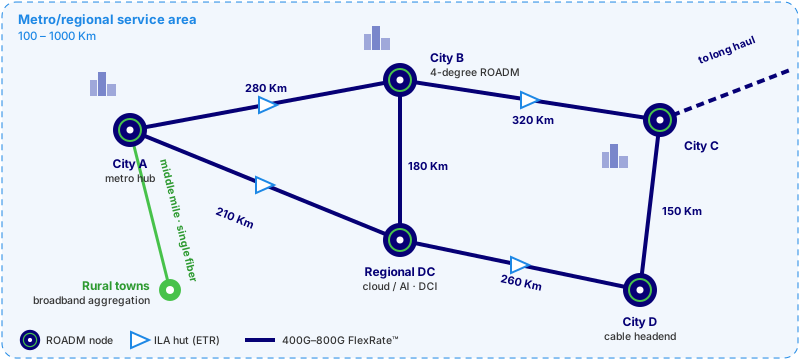
Between the metro edge and the long haul backbone lies the metro/regional network, tying together metro hubs, cable headends, regional and cloud data centers, wholesale points of presence and the middle-mile routes that carry rural broadband traffic back to the core. It has to carry the 10G, 100G and 400G links collected from many edge networks alongside native 400GbE and wholesale wavelengths, across spans of widely varying length and fiber quality, on a topology that is shifting from rings to ROADM mesh. Building new fiber, or loading every router with coherent optics, is slow and expensive. Ekinops tunes every wavelength to its route, fills it efficiently with aggregated services and switches it through a pluggable flexgrid photonic layer, so capacity grows on existing fiber at the lowest cost per bit.
Keeping pace with demand in the metro/regional network raises several challenges service providers have to solve:
“We have been impressed by the Ekinops’ labs and by the quality of their answers to our RFP, as well as the technical expertise demonstrated throughout the selection process. Ekinops’ expertise will play a key role in supporting our network evolution and delivering on our long-term ambitions.”
“This expansion will fully support our broadband initiatives and is really just the first phase of a strategic build for Whidbey Telecom. It will also allow us to expand our wholesale service business providing backhaul services over our fiber network to our partner service providers as far away as Alaska.”
“These smaller mountain communities are remote and need access to affordable broadband service. Ekinops really understood our need for a stable, dependable middle‑mile infrastructure that we can leverage across all the locations in our region in the most cost‑effective manner.”
“The choice of Ekinops, a French sovereign equipment provider, is an obvious one. We can count on Ekinops to support us in the development of new digital highways for several regions, starting with the next “patch” which should take shape this year in Bourgogne-Franche Comté and in Alsace.”
“Ekinops provided a highly innovative, flexible, and cost-effective solution that meets our immediate need for increased capacity and ensures we are built for the future. The partnership helped us make a huge leap forward in our transport infrastructure which in turn significantly improved the customer offerings.”
“Ekinops continues to be a great partner. They deliver the solutions we need when we need them. Their approach gives us the flexibility to scale our network as demand grows.”
The metro edge is defined by many small flows delivered to customer sites, and long haul by a few very high-speed channels crossing countries and continents. The metro/regional network, spanning roughly 100 to 1000 Km, has to do both: it collects 10G, 100G and 400G links from many edge networks and carries them, alongside native 400GbE and wholesale wavelengths, on 400G and 800G channels between cities and data centers.

FlexRate™ modules let you tune modulation format and baud rate so each route runs at the highest line rate its distance allows, up to 800G per wavelength with the PM 800FR04. Flexgrid ROADMs pack mixed-rate channels efficiently, and support for the 96-channel extended C-band maximizes the spectrum available on every fiber pair.
Connecting routers to FlexRate muxponders through low-cost gray interfaces avoids costly router upgrades, preserves router port density and gives each wavelength the transmission performance its route needs. The muxponder also serves as a strict demarcation point between the IP and optical networks. Where pluggables make sense, the PM 400FR05-C2 offers OpenROADM-compliant ZR/ZR+ optics, and router-based coherent wavelengths can be carried on the Ekinops line system.
Yes. The single-slot PM ROADM FLEX-H4M supports two- to four-degree nodes, and larger 10-, 20- and 32-degree ROADM FLEX modules provide colorless, directionless, contentionless and gridless add/drop. Degrees can be added as the network grows, and Celestis NMS handles directionless ROADM-based restoration and 1+1 protection.
The PM OAC20-ETR amplifier and the 2RU C200HC-ETR chassis are built for unconditioned in-line amplifier huts, and the amplifier automatically compensates for fiber aging and for power changes as channels are added or removed. For aerial fiber, the PM 800FR04 offers high-SOP modes that tolerate the rapid polarization changes caused by lightning strikes.
Yes. The PM 100G-AGG, PM O1008MP and PM 100G-XPONDER-MP aggregate GbE through 10GbE, SONET/SDH, OTN and Fibre Channel services into 100G signals, which are then combined onto 400G and 800G FlexRate channels alongside native 100GbE and 400GbE. The PM CRYPTO adds wire-speed AES-GCM 256 encryption for sensitive traffic.
Yes. FlexRate modules can run as alien wavelengths over third-party line systems, and wavelengths from third-party transponders or routers with coherent pluggable optics can be carried and managed alongside native channels on Ekinops line systems. Celestis NMS manages the full flexgrid spectrum, including alien wavelengths, and integrates with your OSS/BSS through a standard REST northbound interface.