Carry more capacity over every long haul mile

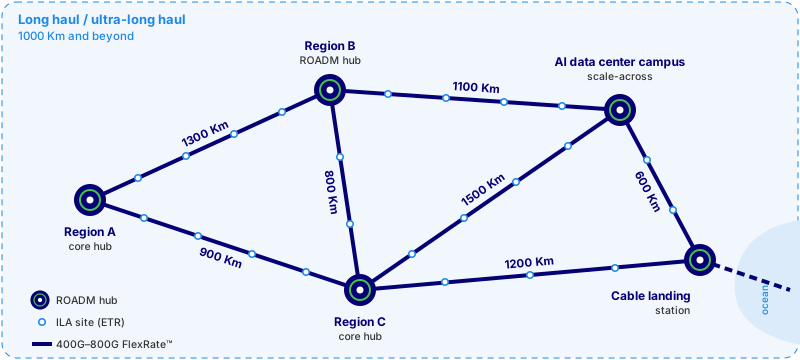
Network operators use Ekinops FlexRate™ coherent transponders, low-noise amplification and flexgrid ROADMs to connect regions, data center campuses and cable landing stations across 1000 Km and beyond.
THE CHALLENGE

Cloud and AI traffic is pushing long haul routes to their limits.

Long haul networks connect the core hubs of entire regions, countries and continents, link hyperscale and AI data center campuses, and carry traffic to and from submarine cable landing stations, across thousands of kilometers and long chains of amplifier sites. Unlike the metro edge, long haul carries fewer, higher-speed channels of 400G, 800G and beyond, so optical performance decides how much capacity each wavelength can carry and how many costly regeneration sites a route needs. Ekinops matches every wavelength to its route with programmable FlexRate™ technology, keeps signal quality high with low-noise amplification, and switches traffic through a pluggable flexgrid photonic layer, delivering the highest capacity over the greatest distance at the lowest cost per bit.

KEY FIGURES

Long haul demand, in numbers

Forecast 2026 growth in WDM long haul equipment, the largest optical segment, to $9.3B (Cignal AI).

0 %

Year-over-year growth in cloud and colocation operators' optical hardware spending in 2Q26 (Cignal AI).

0 %

New intercity fiber miles planned by a single service provider by the end of 2028 (Telecompetitor).

0 M
WHY IMPLEMENT

Where long haul networking pays off

Carrying more capacity across longer distances raises several challenges network operators have to solve:

  • Maximize capacity at every distance

    Run each route at the highest line rate its length allows.
  • Reduce costly regeneration sites

    Cut the equipment, power, space and failure points that every optical-electrical-optical regeneration site adds to a route.
  • Open the network to multiple vendors

    Carry Ekinops wavelengths over third-party line systems and host third-party wavelengths on your own.
Customer testimonials

They go further with Ekinops

  • “We have been impressed by the Ekinops’ labs and by the quality of their answers to our RFP, as well as the technical expertise demonstrated throughout the selection process. Ekinops’ expertise will play a key role in supporting our network evolution and delivering on our long-term ambitions.”

  • “This EKINOPS 100G solution, powerful and simple to set up, meets very well our challenges of increasing our high-capacity routes, which we want fast and flexible.”

  • “We made it our mission to upgrade the network with cutting-edge equipment and technology, as we wanted to ensure that the cable system may continue in operation for many years. Being able to use a French technology company has also been a key factor in our choice since national sovereignty stakes are high for these strategic data flows.”

  • “Having worked with Ekinops on our previous major network expansion, we were already aware of their advanced technology, close, partnership-led approach and world-leading expertise. We are excited to work with them again as key partners in our ambitious expansion plans unlocking next-gen connectivity throughout Africa.”

  • “Central to this mission is extending our backbone network and this cannot happen without a trusted supplier. Working with EKINOPS is helping us to provide competitive and future-proofed high-speed optical fiber services to the market at the lowest cost per bit.”

  • “Ekinops provided a platform for a high-performance long-haul solution. The technical and local knowledge as well as experience of the Ekinops’ team was unsurpassed, and the solution was impressively cost effective.”

FAQ

Find answers to common questions about Ekinops long haul networking.

Long haul spans roughly 1000 Km to 4000 Km, and beyond that into ultra-long haul, connecting regions, countries and continents. Where the metro edge carries many small flows and the metro/regional network a mix of rates, long haul carries fewer, higher-speed channels of 400G, 800G and beyond. Optical performance therefore determines both the capacity of each wavelength and how many regeneration sites a route requires.

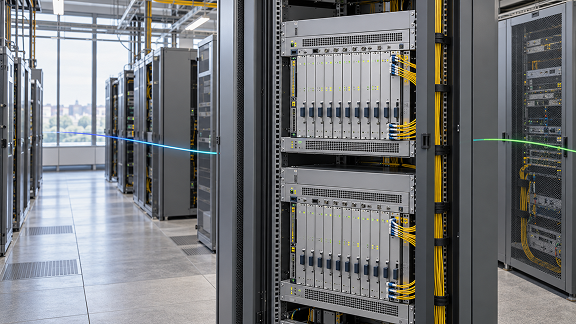
The PM 800FR04 offers eight line modes on the same hardware: 400G-LH and 600G-LH for long haul, 600G-MR and 800G-MR for regional distances, and high-SOP variants for aerial fiber. For ultra-long haul routes, the PM 200FRS02-2 adds 200G LH and 100G ULH modes. Modes are selected in software, with no license fee to change or upgrade the line rate.

Connecting routers to FlexRate transponders through low-cost gray 100GbE and 400GbE interfaces keeps the long haul optical layer independent of router upgrade cycles and preserves router port density and power budget. Each wavelength can be engineered for its route, troubleshooting is simpler, and the transponder provides a clear demarcation point between the IP and optical networks.

Low-noise EDFA, Raman and remote optically pumped amplification (ROPA) keep optical signal-to-noise ratio high across long chains of spans. The PM OAC20-ETR amplifier automatically compensates for fiber aging and for power transients as channels are added or removed, and flexgrid ROADMs balance power on every channel to achieve the highest possible OSNR.

Yes. The PM OAC20-ETR amplifier and the 2RU C200HC-ETR chassis operate from -40 °C to +65 °C in in-line amplifier huts without climate control. For aerial routes, high-SOP modes on the PM 800FR04 tolerate the rapid polarization changes caused by lightning strikes.

Yes. FlexRate modules can run as alien wavelengths over third-party line systems, and wavelengths from third-party transponders or routers are carried and managed alongside native channels on Ekinops line systems. Celestis NMS manages the full flexgrid spectrum, including alien wavelengths.

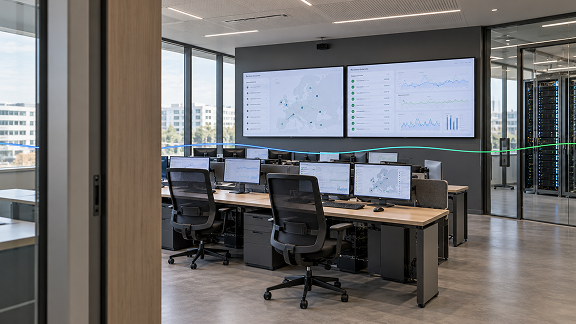
Celestis NMS lets you provision, monitor and troubleshoot the network end-to-end from your NOC, with the optical supervisory channel reaching every amplifier site. Directionless ROADM-based restoration and 1+1 protection keep services running through fiber cuts, integrated OTDR monitoring pinpoints faults, and the PM CRYPTO adds wire-speed AES-GCM 256 encryption for traffic crossing shared infrastructure.

Let's Talk

Ready to carry more capacity across every mile?